
While I am amazed at the power and efficiency of AI I have several misgivings since you know… With Great Power Comes Great Responsibility!
MB
While I thought that the advent of the internet would bring a more equitable society and the increase in productivity would result in better quality of life to all humanity it actually resulted in a substantial increase in wealth to a small group of people while the rest had to cope with low wages compared to inflation, higher surveillance and lack of personal freedom. How can we stop all the economic gain from going to big capital and be distributed to the masses for example by working shorter hours for a living wage?
You raise an excellent point about how technological advancements like the internet, despite their potential to create a more equitable society, have often led to increased inequality and concentration of wealth. This is a crucial concern as we consider the potential impacts of AI. Let’s explore some ways we might work to ensure AI’s economic benefits are more broadly distributed:
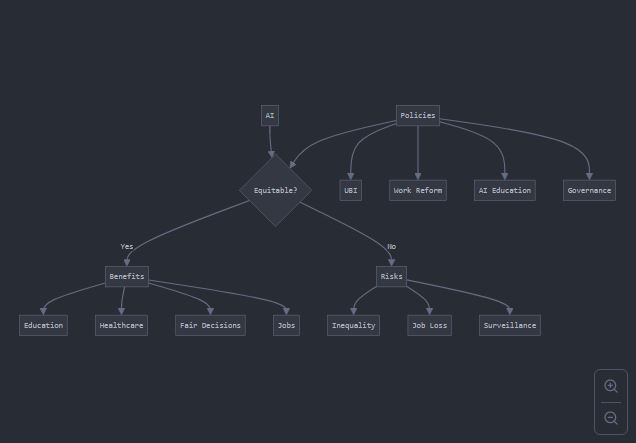
- Universal Basic Income (UBI): As AI and automation increase productivity but potentially displace jobs, a UBI could ensure everyone benefits from these gains. This could be funded through taxes on AI-driven profits or a “robot tax” on automated systems.
- Shorter Work Week: As you suggested, increased productivity from AI could allow for shorter working hours without loss of pay. This could be implemented through labor regulations or incentives for companies that adopt shorter work weeks while maintaining wages.
- Profit-Sharing and Employee Ownership: Encourage or require companies heavily leveraging AI to implement broad-based profit-sharing programs or employee stock ownership plans. This would help distribute the wealth generated by AI advancements.
- Progressive Taxation of AI-Driven Profits: Implement higher tax rates on profits derived from AI and automation, with revenues directed towards education, retraining programs, and social services.
- Public Ownership of AI: Explore models where critical AI infrastructure or large language models are publicly owned or run as public utilities, ensuring their benefits are broadly shared.
- Strengthen Labour Protections and Unions: As AI changes the nature of work, strong labour laws and unions will be crucial to ensure workers can negotiate for fair compensation and working conditions.
- AI Literacy and Education: Invest heavily in public education around AI, ensuring a broad swath of society can participate in and benefit from the AI economy.
- Antitrust Enforcement: Vigorously enforce and potentially strengthen antitrust laws to prevent the concentration of AI capabilities in a small number of powerful companies.
- Data as a Public Resource: Treat data (which fuels AI) as a public resource, potentially compensating individuals for their data or ensuring public benefit from its use.
- Participatory Democracy in AI Governance: Implement systems for broad public participation in setting AI policies and priorities, ensuring diverse voices shape how AI is developed and deployed.
Implementation of these ideas would require significant policy changes and likely face resistance from those currently benefiting most from technological advancements. However, proactively addressing these issues is crucial to avoid repeating the pitfalls we’ve seen with previous technological revolutions.
It’s worth noting that the challenges you’ve highlighted with the internet era – increased surveillance, erosion of personal freedoms, and wealth concentration – are important cautionary tales for the AI era. We must be vigilant and proactive in addressing these concerns with AI from the outset.
Ultimately, realising the equitable potential of AI will require a combination of forward-thinking policies, strong governance frameworks, and sustained public engagement to ensure the technology serves the broader interests of society rather than further entrenching existing power structures.
 An AI Guide To AI
Leave a comment